Understanding the Journey to a Developmental Diagnosis.
Before I proceed in sharing, I want to clarify that I am no licensed professional. I am sharing from my personal and previous healthcare work experience. Therefore I do understand the importance of each appointment, I will proceed to mention.
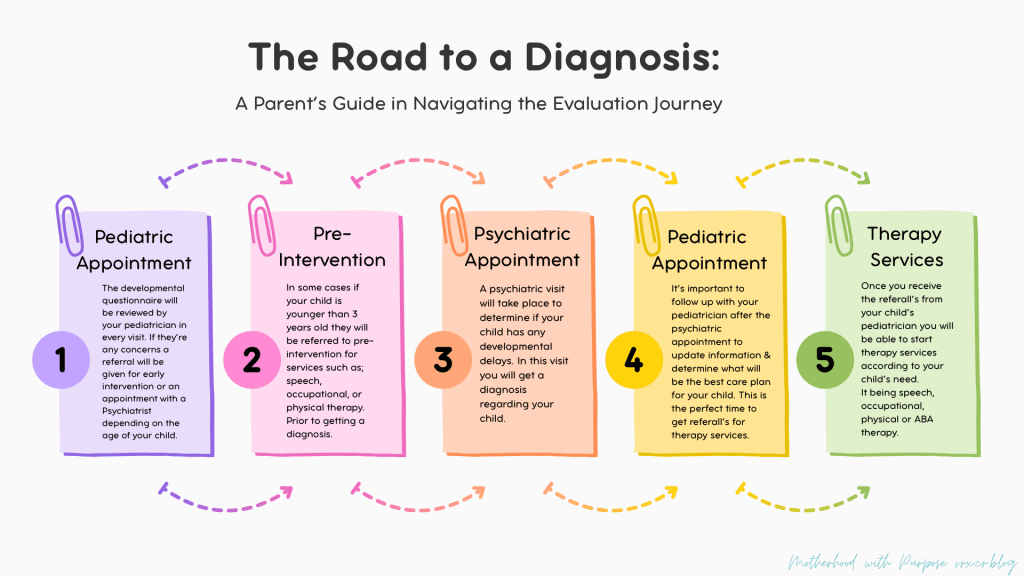
During a child’s development (2-36 months) there will be multiple pediatric visits. The purpose of those visits are for the pediatrician to observe and analyze your child’s developmental milestones according to their age. Developmental milestones are the physical, social, emotional, cognitive, and communication skills children are expected to reach at specific ages. That is why in each visit a Parent or Caregiver of the child fills out the “Ages & Stages Questionnaire”. It’s very important to fill out that questionnaire truthfully since it is reviewed by the child’s Pediatrician. While reviewing the questionnaire if the Pediatrician determines there are any developmental concerns regarding the child they will be addressing that with the Parent or Caregiver.
In my experience there were concerns regarding my children’s development. My oldest son wasn’t speaking in short sentences by the age of 3 and my youngest son wasn’t eating solids, crawling, nor sitting on his own by 9 months. My oldest was referred to a Psychiatrist right away and the youngest was referred to neurologist and early intervention by 15 months old.
After a Pediatric Appointment you will be referred to either Pre- Intervention or a Psychiatric Appointment.
If you are referred to a Pre-Intervention appointment the plan of action will be determined by the evaluations they will do to your child. Determining if he or she might benefit of any therapy services.
If you are referred to a Psychiatric appointment your child will be evaluated by a Psychologist that specializes in children’s development. The evaluation appointment is a very in depth process because it consists of parent/doctor communication and interaction with the child. The whole process might take 2 hours.
In my experience not once did I have to step out of the room, I remained in the room at all times. The appointments did take about 2 hours. The second time around, I proceeded in taking all my written questions. I wished I would have done that the first time around. Be advised please take your questions, paper, and pen for notes.
After the Pre-Intervention or Psychiatric Appointment you will follow up with your child’s pediatrician to update the new information you received regarding your child. That is where a plan of action will take place for child according to his or her diagnosis. During this time it’s important to ask all the questions you may have. At the end of the day you know your child’s best and you will be your child’s best advocate. Don’t be afraid to ask! Ask for therapy referrals if they weren’t given as an option or if needed even ask for a second opinion. You don’t have to go back to the same clinics you got previously referred to. I won’t ever stop encouraging people to advocate for themselves or their loved ones. If we won’t do it who will?
In my personal experience my oldest son got referred to Applied Behavioral Analysis Therapy (ABA) due to his age. While my youngest got referred to neurology appointments, speech therapy, and occupational therapy until he became 3 years old and was given a diagnosis of Autism Spectrum Disorder Level 2 with Speech Impairment.
I hope this information was of benefit to you, if you have any more questions don’t hesitate to reach out.
One appointment at a time. One question at a time. One step closer to understanding your child.
 vrx.cr
Leave a comment